
Meenakshi Srihari offers a critical examination of how art addressing antimicrobial resistance draws on familiar war and superhero metaphors, and shapes how we imagine our entanglement with microbes.
“For art, whatever form it is given, is an icon of our control of the flux of reality”
Sander Gilman, Disease and Representation
A mighty creature is the germ,
Though smaller than a pachyderm.
His customary dwelling place
Is deep inside the human race.
His childish pride he often pleases
By giving people strange diseases.
Do you, my poppet, feel infirm?
You probably contain a germ.
-‘The Germ’ by Ogden Nash
Written in the early 20th century, Nash’s poem for children presents to us a comedic interpretation of the “germ,” a common name for the microbe. Using personification, Nash evocatively paints the microbe with character – that of childish pride, might and the capability to cause disease. This characterisation of the microbe situates it within a moral narrative – one of a rogue and dominant albeit minuscule creature that attacks from within the body. It also paints a picture of the human body as one that ‘contains’ within it creatures, “customarily” residing deep within. Cut to the twenty first century, where in the memoir The Sound of a Wild Snail Eating, Eva Bailey, suffering from Lyme disease, draws a slightly variant characterisation of the microbe within: “[T]he pathogen I contracted was, in its own way, an author; it rewrote the instructions followed within every cell in my body, and in doing so, it rewrote my life, making off with nearly all my plans for the future” (Bailey 2010,166) In both literary representations, the microbe is a colonising force, an invader at war with the body, a writer re-scripting one’s life from within.
Both Nash and Bailey present the microbe using the invader, coloniser or settler narrative, and feed into militarised understandings of disease. They also illustrate a genealogy of microbial metaphors. The movement is historically mediated: the perception of diseases and microbes has shifted from Imperialism and control over land, and hence protection from invaders to the rise of disease and germ theory that helped declare war on disease.
My discussion here is mediated via a case study of art around antimicrobial resistance. I first examine how art mediates the broader social and cultural discourse on microbial diseases by utilising the invasion/military metaphor. I then analyse how humans/combatants are now modelled as superheroes – a parallel to the valorisation of the military, but also to antibiotic-resistant superbugs. I posit that the shared sense of precarity and vulnerability that we experience living in a world already engulfed by war and genocide has rendered the martial metaphor ubiquitous, such that campaigns against antibiotic resistance, which presumably do not call for a war against all bacteria, continue to use the same metaphors. My position is evidenced by the adoption of the metaphor of the superhero (an analogue of the army person) to refer to the good citizen. This is a superhero who lives with the trouble (Haraway 2016).
The article reflects both an observation about public health campaigns and a fear: that the continued use of the martial metaphor, even in situations that do not instigate a naturalised understanding or transference of the concept of war with the phenomenon (here, antibiotic resistance), represents the naturalisation of war itself. I close read one “text” in this piece: a street mural painted by participants of Superheroes Against Superbugs, an Indian public health campaign against antibiotic resistance. I read the aesthetic choices made in this work of public health communication and contextualise its use of the martial and superhero metaphor.
Microbial plots and Metaphor
The martial metaphor emerges from a set of historical relations between actors, agents and cultural productions. It allows us to see a connection between public health, personal battles against disease, and disease as a threat to national security. Lorenzo Servitje, a literary scholar suggests that martial metaphors might have led to the worsening of certain medical discourses, with the widespread use of metaphors such as a “total war on bacterial infections” having material consequences, including antibiotic resistance (2021, pp. 228).
Scholars and critics working both within the literary medical humanities and studies of science and technology within literary texts have approached the narrativization of microbial interactions from different perspectives. Servitje, in his work on the martial metaphor, studies the emergence of the metaphor through its use in literary texts of the nineteenth century, arguing that the widespread use of the martial metaphor is a result of its careful construction and development (2021). Catherine Belling’s earlier hypothesis, that texts studying the interaction between humans and microbes “lead readers to imagine themselves in relation to nonhuman temporal and spatial scales” (2003, p. 85), leads us to the question of what story about human society emerges when this imagination is set in place.
The SAS Mural
Antibiotics, biomedicine’s response to microbes, serve as a tool the warring human faction uses to wage war against microbes. With antibiotic resistance, it falls upon scientists and the consumers of antibiotics to acknowledge that this weapon is double-edged (to lapse into metaphor myself), and that antibiotics, when improperly consumed, can do more harm than good.
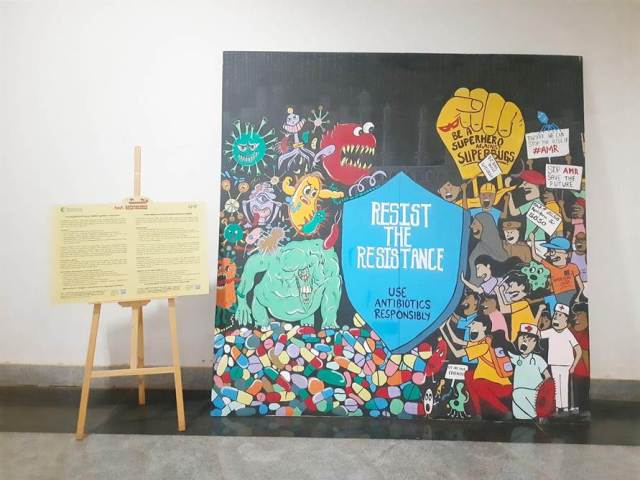
I came across the SaS mural during an awareness event organised by Superheroes Against Superbugs at the University of Hyderabad. This mural also serves as the banner on the campaign’s website landing page. It is densely populated with several colourful elements, but the most noticeable aspect of the display is the binary it presents. On its left, there are several colourful, monster-like creatures that one recognises as different kinds of bacteria because of tell-tale anatomical features. For instance, a few of them contain flagella, and pili, the hair-like structures that surround bacterial cells. There are conical bacteria that might represent Gram-negative bacteria (Salmonella), and spherical bacteria with pin/cone-like structures that might be coccus bacteria. While these are indeed demonised bacterial forms, they are also not realistically portrayed. The comics theorist Scott McCloud has postulated that this sort of simplistic representation of form can help in universalising the characters of the context being portrayed (1993).We see Sander Gilman’s postulation of representation as icon returning here.
The monster-bacteria stand on top of a mound of pills – colourful as candy, lifeless and numerous. There is already some dissonance this image creates for the uninformed spectator that the pills, considered biomedicine’s weapons against bacteria, are being stomped on by monstrous bacteria. They are on the same side of the binary, even as one is used to annihilate the other.
The right side of the mural contains life forms more familiar to us, the humans. SAS’s depiction of these humans is culturally grounded. There are women and men from various professions – health workers, students, commonfolk, who are representative of the city of Hyderabad. The city itself appears in the background of the whole scene, across both sides of the mural, as the silhouette of the Charminar, an iconic Hyderabadi monument. Some of the characters wear t-shirts that say nakko, an imperative “no” in Dakhni, the local dialect. Interestingly, there are microbes on this side as well – most conspicuously, a bacteriophage [a virus that infects and replicates inside bacteria]. These are not demonised and call themselves friends.
There are thus cultural, verbal and affective semiotics at play here.
Firstly, the mural uses two creative and metaphorical strategies to establish the bacteria as the ‘other’ and the humans as entangled: personification, specifically demonisation, and the production of both humans and nonhumans on the same scale. It appears that the bacteria are caricatures of monsters – while they have eyes, feet, hands, mouths, they have only one eye, or just a pair of feet and no hands, or several eyes, or an anatomical structure with no clearly discernible body parts. These are then picturised as life forms, we associate with, cue both the familiar bacterial features and human ones, but also find unfamiliar and monstrous – cue the abnormal growth, cartoonish and garish colours, the “evil” laughter, etc. These are positioned along enemy lines. The humans and the bacteriophage – admirably holding up a shield and no weapons – are on the defence but are also affectively united in resistance. The Charminar serves as a reminder of Hyderabad’s long history of fighting epidemics and of one of the reasons postulated for the construction of the monument in 1591 – to mark the end of a deadly plague.
The mural’s visual vocabulary echoes what Sontag identifies as the sci-fi inheritance of disease imagery in Illness as Metaphor. The monstrous microbes represent the invader narrative, indicating hostile occupation and the medieval plague metaphor of moral contamination. But the image also complicates Sontag. Rather than nature’s fury, the mural hints that it is human-driven mutations that have led to bacterial mutations and antibiotic resistance, making AMR a consequence of human action, not “cosmic fury”. The brightly coloured pills satirise contemporary pharmaceutical consumer culture. The mural reanimates the martial metaphor while showing that humans have enabled microbes to evolve.
In painting a diverse group of humans, nonhumans, epistemological sources, local languages, and situatedness, the mural acknowledges multiple vulnerabilities, including multispecies vulnerability.
Antibiotic resistance complicates the martial metaphor. It describes the capacity of microbes to resist the effects of the medicines used to treat them. Here, one might stop and ask if the enemy is the resisting bacteria, the disease caused, or the ecological conditions that enable resistance to emerge. The metaphors of “enemy” and “ally” position humans and bacteria in a relationality or sociality that one ascribes conventionally to human society.
The vulnerability of humans, that is, their susceptibility to being wounded, comes into play with relationality, that is, when the vulnerability in another is recognised. The political philosopher Judith Butler argues that this is not a chink in humankind’s armour, but a basis for social justice and solidarity.
With AMR and its representations, a posthuman vulnerability is imperative for recognising one’s relationality with the nonhuman other. The narrative structure emulates the symbiotic relationship structure that microbes seem to share with one another. Posthuman vulnerability reinforces the now oft-heard idea of interrelatedness and symbiosis that microbial ecosystems must adopt as a method of existence – and so must humans. This structure decentres the human and centres the ecosystem at large. The incorporation of both microbes and humans on one side softens the demonisation and stigmatisation of the microbe that the binary presents. However, the campaign positions the binary itself as being imperative to the message making.
In the antibiotics crisis, awareness campaigns seem to urge the public towards considering the following directions: that the medical fraternity avoid the non-judicious prescription of antibiotics; that as patients, people must question the excessive prescription of antibiotics by doctors, and as consumers, avoid its unprescribed over-the-counter purchase; and that patients must complete the prescribed dosage to reap its benefit and prevent harm. The nature of each direction is different, insisting on the doctor’s and patient’s ethical jurisdiction and on the communication of scientific, medicalised knowledge about the functioning of the immune system to the patient.
While the self–other/enemy divide proves instrumental in message making, the rhetoric used to situate microbes along enemy lines is moral – there are thus good bacteria and bad. As with any public messaging around crises, it becomes the responsibility of the good citizen to be held accountable.
Citizen as superhero
Comics that emerge in times of crisis have also turned to the trope they are most popular for – that of the superhero. In her book-length study, Why Comics, Hilary Chute reads comics’ responses to 9/11, pointing out that in addition to comics that served as personal testimonies of the experience, such as those by Gary Snyder and Art Spiegelman, Marvel and DC also paid superhero tributes to the calamity in issues starring Spider-Man and Superman. Two claims emerge from her reading: one, that the superhero, for the first time in American comics, also admitted to some sort of helplessness. Two, the idea of the superhero had become more democratised, with ordinary, real-life citizens designated as superheroes in everyday life. As Chute announces, superheroes are “both a typological category and a cultural truth” (70). In times of crisis, the figure of the superhero also appears to have a moral duty. But apart from what the superhero comic can do culturally, they offer to us a way to examine representative bodies.
The superhero trope for citizen-combatants, drawing from the science-fictional superhero trope, is only the natural successor in the list of analogies that the conceptual metaphor of war can produce. Several cultural productions, specifically comics, also employ the apocalyptic metaphor, which performs the cultural work of pitting the present in its context of extreme crisis with a dystopian future that might arise because of it. It is thus a denaturalised mode of imagination, as are the figurative language and landscapes that characterise most sci-fi or dystopian fiction. In contrast, it appears that the martial metaphor is a rumination of the consequence of the past, not just in what it represents, but also in its collectivising intentions. Apocalyptic renditions of AMR, with their complex plotlines, prompt the reader to hypothesise a future; the martial metaphor, instead, engages the reader in conceptual vocabulary around war, such as resistance, resilience, and defeat/victory. In bringing together the martial metaphor and the citizen-as-superhero, the SAS mural seems to highlight how one lives with ubiquitous trouble and resists with the knowledge of one’s entanglements and sympoietic relatedness with the ecosystem. However, it also grapples with the aesthetic challenge of representing such a crisis without stigmatising microbes. Living with the trouble in the post-antibiotic era necessitates thinking beyond the binaries of enemy/ally to scales that account for posthuman linkages.
About the author
Dr Meenakshi Srihari is an Assistant Professor at Sai University, Chennai where she teaches literature and writing. Her research focuses on the medical/health Humanities. She is particularly interested in auto/biographical accounts of illness and graphic medicine. Reach out to her at meenavid79@gmail.com.
References:
Bailey, Elisabeth Tova. 2010. The Sound of a Wild Snail Eating. Algonquin Books.
Belling, Catherine. 2003. “Microbiography and Resistance in the Human Culture Medium,” Literature and Medicine, vol. 22, no.1, pp. 84-101.
Chute, Hillary. 2017. Why Comics? From Underground to Everywhere. Harper.
Gilman, Sander L.1988. Disease and Representation: Images of Illness from Madness to AIDS. Cornell University Press.
Haraway, Donna J. 2016. Staying with the Trouble: Making Kin in the Chthulucene. Duke University Press.
McCloud, Scott. 1993. Understanding Comics: The Invisible Art. Harper Perennial.
Servitje, Lorenzo. 2021. Medicine is War: The Martial Metaphor in Victorian Literature and Culture, SUNY Press.
Sontag, Susan.1978. Illness as Metaphor. McGraw Hill Ryerson Ltd.


I really like how this post explains the topic step by step. The clarity and structure make the content informative and enjoyable.
I found this article engaging and educational. The explanations are clear, and the ideas are presented smoothly.
I found this article very informative and enjoyable to read. The explanations are clear, relevant, and easy to understand. Thank you for sharing quality content that helps readers build knowledge and confidence.
Wonderful article! The writing is engaging, the information is practical, and the structure makes it easy for readers to follow along. I truly appreciate the effort behind this post.
learn more here casinowulcan777.com