
Shruti Ghosh explores zine making as a method for “queering” knowledge production in health research.

“What if the most urgent truths about queer life in India can’t be footnoted, theorized, or published in glossy academic journals—but must be handwritten, stitched, and smuggled through photocopiers? What if failure, grief, infertility, and unruly emotions are not just lived realities, but methods?”
(Halberstam, 2011)
I came to zines by accident—through a borrowed, photocopied pamphlet tucked into a pile of Judith Butler readings during my Master’s coursework at Jawaharlal Nehru University, Delhi. The zine, barely ten pages long, hand-drawn, its edges burnt with a candle for “aesthetic appeal”, spoke of queer heartbreak, rented closets in Delhi flats, and surviving Section 377— which criminalized homosexuality in India—before its repeal. It provided no author attribution, references, or “theoretical framing.” It wasn’t academic, and it didn’t pretend to be. It wasn’t polished. But it was true. In its vulnerability and handmade grit, it captured more about queer life in India than any peer-reviewed article ever could.
Since then, zines have become more than an object of interest for me. They’ve become my method—a way of knowing, documenting, resisting, and relating. As a queer researcher studying infertility and graphic narratives, zines offer me a queer, embodied, and anti-institutional methodology, one that resonates deeply with the fractured, invisibilized, and nonlinear journeys of queer people in India and elsewhere. In this piece, I turn to the work of thinkers like José Esteban Muñoz, Sara Ahmed and Jack Halberstam to make sense of these feelings and stories.

Zine as Method: “Queering” Knowledge Production
Zines, by nature, fail the standards of scholarly legitimacy; they are amateur, ephemeral, self-published, anonymous, and emotional. Zines thrive in their refusal to meet the polished, sanitized standards of academic publishing. And in that failure, they succeed spectacularly in capturing the mess of queer existence. They allow for affect, speculation, and intimacy. They resist categorization and archiving. As Halberstam writes, “under certain circumstances, failing, losing, forgetting, unmaking, undoing, unbecoming, not knowing may offer more creative, more cooperative, more surprising ways of being in the world” (Halberstam, 2011).
There is a radical potential in their mess. Within mainstream dominant modes of thought, mess is often treated as excess, unruly, undisciplined, and unproductive. Yet for queer subjects, particularly those negotiating the medicalized domain of infertility, mess is frequently not only inevitable but generated through knowledge discourses. As Sara Ahmed argues in “The Cultural Politics of Emotion” (2004), emotions are “sticky”: they adhere to bodies, circulate through time and space, and accumulate meaning through repetition.
Zines operate as such sticky surfaces. They are not ‘neutral’ objects but ‘affective repositories’—spaces or objects that hold and transmit emotions, memories, and lived experiences. They are tear-stained, coffee-marked, ink-smeared, and annotated with rage, shame, longing, and defiance. They do not strive for objectivity; they embody feeling as method.
Zines do more than document personal experience. They constitute “affective commons” —spaces where those marginalized by reproductive norms can witness each other’s pain, rage, ambivalence, and resilience (Berlant 2007). In circulating this mess, unapologetically and without guarantee of resolution, zines enact what Lauren Berlant might call “slow death in the register of survival”: not a heroic overcoming, but a tender, stubborn inhabitation of what is. Here, survival is not sanitized. It is sticky, stubborn, and deeply felt (Berlant 2007).
Situated Knowledge and Embodied Archives

Donna Haraway’s concept of “situated knowledge” challenges the notion of detached objectivity in knowledge production, emphasizing instead that all knowledge is partial, embodied, and shaped by the position of the knower (Haraway, 1988). Zines, in contrast to conventional academic texts, foreground their embeddedness in lived experience. They do not conceal their partiality, messiness, or subjectivity; rather, they embrace these as integral to their epistemological value. In this way, zines can be seen as creating embodied archives— collections of affect, memory, and resistance that emerge from marginalized queer lives. They do not seek to erase the author’s body or context; they inscribe it into every page.
For many queer Indians, particularly Dalit (oppressed caste communities in South Asia), trans, disabled, and working-class queers, academic spaces remain violently exclusionary. Zines circulate in safer spaces: at Pride stalls, on Instagram pages, in Queer Collectives, and at underground poetry slams. A compelling Indian precedent for this can be seen in Shruti Arora’s zine “The Queen” (2019), where the protagonist navigates gender dysphoria, societal surveillance, and maternal expectation through shifting visual registers that combine myth, surrealism, and clinical spaces. The protagonist’s womb becomes a political site evoking what Gayathri Gopinath calls “ephemeral and non-teleological” expressions of queerness. (Gopinath 2018, 149)
Zines as Decolonial Praxis
In an Indian academic landscape still haunted by colonial metrics of discipline, structure, and respectability, zines offer a way to speak from the margins without seeking entry into the center. They let me write about infertility as a queer issue, not just clinical, but political and social. They allow my narratives to remain partial, non-linear, handwritten, annotated with blood test results, diary fragments, and drawings of ovaries shaped like rotten pomegranates. No journal would publish these, but they are mine. They are real.
Moreover,the very act of writing about queerness and reproductive anxiety is a “decolonial methodology”. Decolonial methodology can be defined as a way of doing research that rejects colonial ways of thinking and values knowledge from marginalized communities (Thambinathan and Kinsella). Our bodies have long been controlled through casteist reproductive policing, colonial moralism, or nationalist heteropatriarchy—a social system in which heterosexuality and male dominance are enforced as the norm, marginalizing queer identities and subordinating women and gender-diverse people.
The figure of the “ideal Indian woman” is persistently constructed as heterosexual, fertile, compliant, and sacrificial. Such a construction reaffirms the logic of “reproductive futurism” (Edelman 2004) — the normative assumption that the continuity of society rests upon heterosexual reproduction, marginalizing alternative modes of living and relationality by positioning it as a moral imperative and a national duty (Edelman 2004). In choosing to zine the experience of infertility, I disrupt this normative figure. I assert a body that is queer, non-reproductive, and still intact, not despite its deviation from normativity, but because of it.
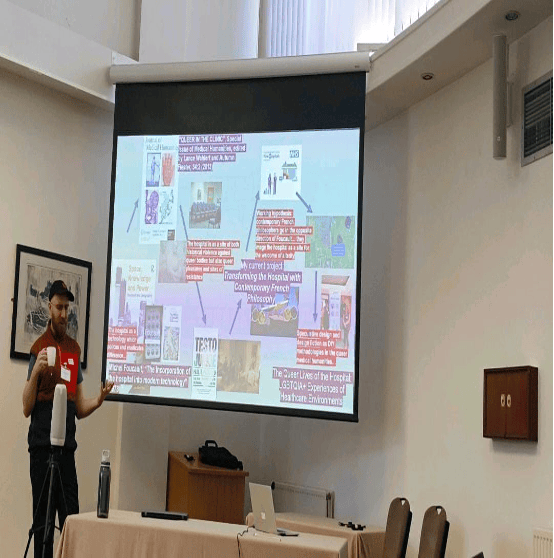

Attending the Queer Medical Humanities PhD School at Durham University, the zine turned into a ‘method’, rather than an accident. The reflexivity I developed there, especially around privilege, voice, and authorship, pushed me to interrogate my own Savarna i.e. upper caste Hindu Brahmanical privileged standpoint. It helped me realize that zines are not just about expression; they are about positionality—one’s social standpoint with respect to one’s class, caste and gender. And they require accountability.
While I write from a Savarna standpoint, I now remain acutely aware of my positionality. I intentionally engage with the zines of Dalit, queer, and trans creators whose embodied archives have long chronicled reproductive injustice, even before academia was vocal to their sufferings. Their work exists not simply as aesthetic expression but as an archive of resistance against coerced sterilization, institutional erasure, and the pervasive silence surrounding queer reproductive trauma. Moreover, the workshops gave me the language to ask: Whose mess gets archived? Whose grief gets footnoted? Whose failure gets theorized? Zine-making became not just a creative outlet but a methodological commitment to make space, to feel alongside, to remain ethically unsettled.
To zine, then, is to refuse the colonial script of reproductive normativity. It is to speak from the underside of respectability, to reclaim the wounded body as a site of insurgent knowledge, and to insist that queer lives, however fragmented, infertile, or unfixed, are not only liveable, but radically knowable on their own terms. I still have that first zine. It’s crumpled and faded now, tucked between books on my shelf. I don’t know who made it. But it continues to speak to me. It reminds me why I write. Why I zine. Over time I’ve realised that some truths are too urgent to wait for a journal’s approval. Some wounds can’t be peer-reviewed. Therefore, to zine is to survive. To refuse sanitization. To make knowledge in the register of feeling. To say: “I am here. I am grieving. I am messy and I matter”.
About the author
Shruti Ghosh is a PhD scholar at the Centre for English Studies, Jawaharlal Nehru University. Her research explores infertility narratives in India through decolonial and queer methodologies, focusing on how zines and other alternative forms of knowledge (memoirs, comics) challenge medicalized and institutional framings of reproduction and bodily autonomy.
About the 2025 Medical Humanities PhD School
This post is part of a collection of contributions from attendees of the Queer Methodologies in Medical Humanities PhD School which took place in Durham in March 2025. The PhD school was funded by Wellcome, as part of the Discovery Research Platform for Medical Humanities at Durham University, and the Centre for Medical Humanities and Bioethics (CMHB) at Linköping University.
All articles in this collection can be found on this page: 2025 Queer Methodologies in Medical Humanities PhD School.
References
Ahmed, Sara. 2004. The Cultural Politics of Emotion. Edinburgh: Edinburgh University Press.
Arora, Shruti. 2019. The Queen. Self-published zine.
Barker, Meg-John. 2025. Queer Creative Health 2: Researching Ourselves. Illustrated zine. London: QueerCircle.
Berlant, Lauren. 2007. “Slow Death (Sovereignty, Obesity, Lateral Agency).” Critical Inquiry 33 (4): 754–780.
Gopinath, Gayatri. 2018. Unruly Visions: The Aesthetic Practices of Queer Diaspora. Durham: Duke University Press.
Halberstam, Jack. 2011. The Queer Art of Failure. Durham: Duke University Press.
Haraway, Donna. 1988. “Situated Knowledges: The Science Question in Feminism and the Privilege of Partial Perspective.” Feminist Studies 14 (3): 575–599.
Muñoz, José Esteban. 2009. Cruising Utopia: The Then and There of Queer Futurity. New York: NYU Press.


